A Darker Roast, On Purpose
Almost everything we roast is light to medium. A customer asked for the opposite, and here's the batch, the curve, and the reasoning.
Almost everything on our roster is roasted light to medium, because that’s what keeps origin character in the cup. So this is the exception, and it’s worth writing up because it shows what the roast alone can do.
A customer asked for something specific: low acidity, and an espresso that pulls creamy. Not a flaw to hide, just a preference. That request points in one direction, and it isn’t our usual one.
Why the request means darker
Acidity and body are largely set by how far development runs after first crack.
- The acids break down with time and heat. Chlorogenic acids, the main source of a coffee’s brightness, degrade as the roast develops. Push development long enough and the sharp, bright notes flatten into something rounder and softer.
- Body and crema build at the same time. Longer development caramelises more of the sugars and, near second crack, starts bringing oils toward the surface of the bean. In espresso those oils and the extra soluble solids are what produce a thick crema and a creamy mouthfeel.
So “low acidity and a creamy espresso” is really one instruction: develop it further than we normally would, and take it close to, or just into, second crack.
Which coffees
Not every lot can take this. The delicate ones, the Gesha and the washed Ethiopians, would be flattened into nothing worth drinking. So we reached for the two with the body and the forgiving roast margin to handle it: the Peru Colasay and the organic Mbale Mountain from Uganda. The Mbale already sits at the dark end of our range and leans toward chocolate and espresso. The Peru takes a wide span of development without falling apart. Both are washed, and both carry enough weight to hold up under a darker roast.
We ran them as two separate batches rather than blending them. Single origin still means single origin, even when the roast is the unusual part.
The batch
Here’s one of the two curves. First crack landed at 12:14 and 198.6 °C, right where it usually does. Then, instead of dropping a few minutes later as we would on a standard roast, we held it.
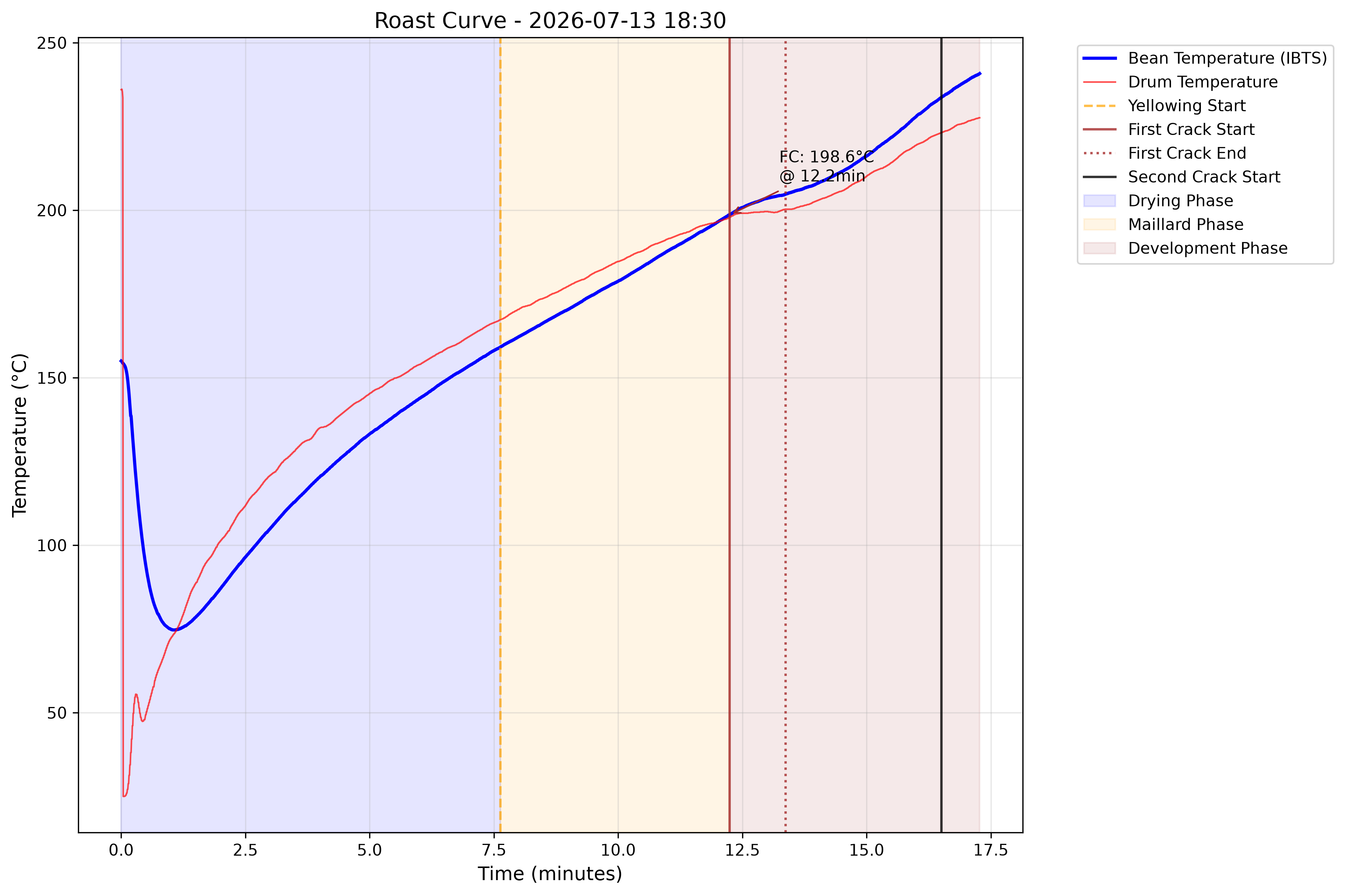
Development came out at 29% of total roast time. For context, our standard profile runs closer to 20%, and across every batch we’ve logged we’ve entered second crack twice. This one went in deliberately, at 16:30, and dropped at 240.8 °C, more than twenty degrees hotter than a normal batch.
That’s a real departure from how we usually work. We wrote on the roasting page that we almost never reach second crack, and that’s still true. This was a decision made for a specific cup, not a change to the house style.
What it produced
The tradeoff is exactly the one you’d expect: origin character gives way to roast character. The clarity and brightness that distinguish these two lots at a normal roast are mostly gone. In their place is a low-acid, chocolate-leaning cup with real weight, and an espresso that pours thick with a lasting crema. For the person who ordered it, that’s the point, not a loss.
It’s worth being plain about that trade rather than pretending a dark roast keeps everything a light one has. It doesn’t. Roast development is a tool, and here the job was body and softness rather than clarity.
We’ll do this occasionally
Small-batch roasting means we can take a request like this without turning it into a product line. If you want something roasted for a particular cup, low acidity, a darker profile, an espresso that behaves a certain way, tell us what you’re after. Sometimes it’s a coffee we already make. Sometimes, like this one, it’s a batch developed on purpose for the result you’re describing.